Tuesday, December 07, 2021

A Wombat, A Nativity and A Mystery

 I've been pulling from my pile of Christmas stories for use in worship during Advent.  In one of my very favorites Australian animals put on a nativity play.  Wombat is eager to try out for a part.  Not only do we learn that a numbat and a bilby are animals (both - no surprise - marsupials), we see these adorable animals comfort poor Wombat when none of the roles is quite right for him.  Until...they all realize that there's one role that's just perfect.  


Oh. My. Goodness.  This book will definitely make your heart grow three sizes.  Pastor Megan read it on Sunday because I was keeping my coughs and sneezes at home.  You can see that portion of worship on our YouTube channel.
Another one of my favorites for Christmas is The Nativity.  This gem takes the King James Bible version of the nativity story (I edit liberally while reading) and adds Juli Vivas' gorgeous illustrations.  I wrote about it a couple years ago and many of our families received one with their Advent materials last year, thanks to the generosity of Rex and Lenae, who also love it.  If your family didn't get one yet, please let me know!

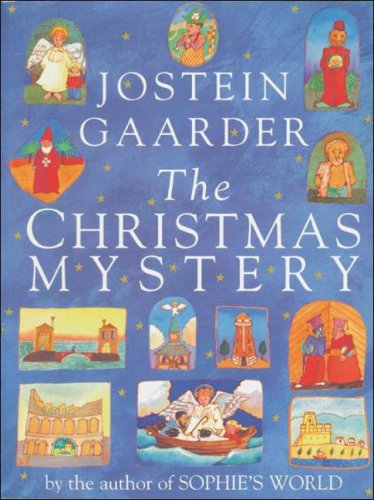
The Christmas Mystery: Gaarder, Jostein: 9781559213950: Amazon.com: BooksFinally, I'm currently on Day 7 of The Christmas Mystery by Jostein Gaarder.  This one's not a picture book, though it does have lovely chapter illustrations by Rosemary Wells, whose style I recognized immediately from the Max and Ruby and Yoko books. In a little bookshop in Norway, Joachim discovers an old advent calendar label "Magic Advent Calendar." Each day when he opens a door he's thrown into the story of another child - a little girl from 50 year ago.  In the company of an angel, a lamb, a shepherd and likely other characters I haven't learned of yet, a little girl named Elisabeth is running backward in time and space to the stable in Bethlehem where Jesus was born. 

I love a story within a story. I love a little magical realism.  I love fiction that takes faith seriously. And I love that at this moment there isn't much that interests both my teen and my six-year-old but so far they're both into it!  The chapters are short, fun to read aloud, and I could totally see this becoming an Advent tradition in our household.  One that's way better than chocolate - however fairly traded it is.  I offer gratitude and appreciation to Cindy Spencer for introducing me to this one. 

A blessing on your Advent reading and other activities.  

Wednesday, November 24, 2021

Breath and Bones


Our bodies are pretty amazing. It is a marvel to me when I really reflect on it, that these bags of meat and bones become bodies that breathe and balance upright, never mind do all the beautiful things they can do! The text from Ezekiel that we're hearing in worship this week speaks to specifically to the breath of God enlivening dry, dead bones. His experience with the breath of God got me thinking about a favorite craft from when I was a kid: turning my name into a body of bones.

I'm pretty sure we'd have done it on Halloween, but I like connecting it with this story and the prophecy of Ezekiel to the bones: Let these bones live! It's a fun way to introduce the bonkers story of Ezekiel to someone while getting your fingers a little sticky together.

I put the instructions to the bones craft below. Before you jump there, I want to offer you a moment to breathe. Do it now! Take a deep breath. Now, if you want to keep breathing, you can use these words as a prayer:
Breath in: Breathe upon these bones.
Breath out: Let these bones live.
Repeat as necessary.

It's, like, science or something that when we still ourselves and breathe we decrease our heartrates and reduce our stress. Breath makes space. May this prayer make space for the life of the Divine in you and give your weary bones new life. Now onto the craft...

Here's what you need: A piece of colored paper or construction paper, a have sheet of white paper, scissors, glue and a pencil.

Fold the white paper in half the short way and write your name with the bottom of the letters on the fold. Then fatten out the letters, making sure they touch each other.

Cut around the letters and unfold.

Glue down the unfolded letters to make the rib-cage of the living bones, pencil side down. Use strips cut out from the remaining white paper to make legs and arms and an oval for the head.

Voila! May your bones be enlivened by the Spirit of God within you.


Tuesday, November 09, 2021

Opting Out: Chosing NOT to Register for Selective Service

Thursday is Veteran's Day. Some of our kids might be encountering assignments in school that invite them to write about and celebrate veterans, assemblies that either glorify military or recruitment visits by armed forces representatives. When I was a kid in Canada, we glued crepe paper poppies to construction paper and copied out the poem "In Flanders Fields" by Canadian poet John McRae. It memorializes fallen veterans and invokes the living to "take up our quarrel with the foe." Honestly, I hadn't re-read that poem for many years and yikes!

As peace-making followers of Jesus, who want to encourage our children to encounter calls to militarism or even to remembrance with alternative kinds of activities. In the past, some of our parents have worked with their children on alternatives like researching heroes of peace in their families or communities, or excusing their children from attending Veteran's Day assemblies. We will not take up the quarrel, thank you. But until recently, many families haven't felt like they had an alternative for registering for Selective Service.

The Selective Service System is a program by which young men who have turned18 are required within 30 days to join a registry that names them as eligible for military service in the case of the draft. There is no way to register as a conscientious objector pre-emptively. There are almost no exceptions, though one of the things that is a part of my work with youth in our congregation is returning periodically to a Conscientious Objection registration, which helps young people (of all genders) record their beliefs about war and violence and the call of Jesus to peacemaking. In the case of a draft, those young people would have their beliefs documented should they claim CO status.

There is good news! I learned earlier this year that those who refuse to complete registration to the Selective Service System are no longer excluded from receiving federal financial aid. Until now, failing to register meant that access to FAFSA was barred. This has been one of the major hang-ups of many young people who are trying to decide whether or not to complete the application. Choosing to opt out of adding your name to the list of those willing to be "take up the quarrel" doesn't seem like much of a choice if it means that you then won't have money for higher education.

That doesn't mean there aren't still some consequences: those who are of age "must register to be eligible for state-funded student financial aid in many states, most federal employment, some state employment, security clearance for contractors, [some federal] job training...and U.S. citizenship for immigrant men."

And "failure to register with Selective Service is a violation of the Military Selective Service Act. Conviction for such a violation may result in imprisonment for up to five years and/or a fine of not more than $250,000." (More on all that here). However, my understanding about those consequences - particularly the legal implications - is that no one has been prosecuted for decades.

One additional tidbit that I learned is that in some states, any application for a state learner’s permit, driver’s license or renewal, or I.D. card equates consent to have information automatically transferred to Selective Service for registration if you are between the ages of 18-26. But Washington is not one of those states! So that's an additional heads up to look carefully at those forms to make sure you're not opting in when filling out those first forms for learners permits or renewing drivers' licenses.

Folks, however your spending this Veteran's Day, may the peace of Jesus light your way.

Tuesday, November 02, 2021

November: Indigenous Heritage Month


With the beginning of November comes the beginning of Indigenous Heritage Month. It's seeds were sown in 1976 when a Cherokee/Osage politician named Jerry C. Elliott-High Eagle authored Native American Awareness Week legislation. Ten years later, in 1986, the first week recognizing the heritage and cultural significance of indigenous peoples was proclaimed by Ronald Reagan who named November 23-20 American Indian Week. Finally in 1990, George W. Bush named November National Native American Heritage Month.
In worship we adults always acknowledge the Duwamish on whose land we gather. We hope that's language that is become internalized for our children who are present as well as for ourselves. But how else can we engage with indigenous culture and heritage in a respectful way? I went into an internet rabbit hole. The article Celebrating Native American Heritage Month: Do's and Don'ts by Ruth Hopkins (Dakota/Lakota Sioux) has some base-line starting places but I have some more specific suggestions.

Locally, we have such a great resource in the Duwamish Longhouse. You could visit the Longhouse for special exhibit The Spirit Returns or for the native art market on the weekend after Thanksgiving. Or explore contemporary and historical indigenous art at The Burke Museum, where you can also treat yourself to some fry bread at Off the Rez Cafe. (For more about fry bread, I definitely recommend Fry Bread by Kevin Noble Maillard (Seminole). He tells so much history of indigenous people in North American through a fun rhymey book with beautiful illustrations. Follow the link for a video of him reading and talking about it).

Looking for other literature for youth and children I rediscovered the American Indians in Children's Literature blog. Not only does Dr. Debbie Reese (Nambé Pueblo), author of the blog, post her 'Highly Recommended" books for children, she also shares red flags and things to avoid. Her (very long) list of Thanksgiving books to take off your shelf include some that might seem like beloved chestnuts: eg. Charles Schultz's Peanuts crew, Richard Scarry and the Berenstain Bears. Dr. Reese also offers ways to take action with publishers who are distributing books containing harmful images and ideas and so many other resources and tips for choosing kid lit featuring indigenous people.

A couple of authors that I can recommend are Richard Van Camp (Dene) Julie Flett (Metis) Cynthia Leitich Smith (Muskogee) and Louise Erdrich. All of these authors write both about indigenous people in history and about the lives of indigenous people now - combating the myth that somehow Native folks have disappeared and are a part of our history but not our present.

If you'd like to throw your money at indigenous artists and entrepreneurs, visit 8th Generation to purchase their products or see their guide to Native owned establishments and holiday events around Seattle. Check out the curated gift box of indigenous books and products by Raven Reads (they have a specifically kid-focused box), or the gifts boxes or other products by Sweetgrass Trading Company or the subscription boxes by Indigenous Box (I'm seriously considering this for my sister-in-law for Christmas).

If you have ideas or suggestions or practices that honor and recognize First Nations neighbors or Thanksgiving practices that upend the traditional narrative, I'd love to hear them.

Wednesday, October 27, 2021

Listen Past the Noise


This week in worship, the text from the narrative lectionary is the story of Elijah, who goes up on Mt Horeb to encounter God. He experiences an earthquake and a fierce wind and great fire. God isn't in any of those noisy and mighty phenomena. Instead, God come to Elijah in a "still, small voice" (KJV) or "a sound. Thin. Quiet" (CEB) or "the sound of sheer silence." (NRSV) While each of these versions translates the experience differently, it's clear that though sometimes God does who up with great force, this time Elijah needed to listen very closely and careful to hear God speaking.

In the time with children I'll be featuring Gabi Snyder's book Listen, which invites readers to "Listen past the noise." I love the way this book illustrates the practice of mindfulness and attentiveness. From the moment the featured character steps out of her house into the "big, wild world," she's surrounded by noise: barking dogs, honking cars, zooming motorbikes. She closes her eyes. "What if you stop... and listen? Can you hear each sound?" the book asks. She keeps noticing: not just the thump-thump of jump ropes and the crunch of gravel, but words of delight and hurt spoken by friends and classmates.

The care with which Gabi Snyder invites her readers to attend to the world around them reminds me of the mindfulness practice of noticing with the senses. Take a minutes to notice:
- 5 things you can see
- 4 things you can hear
- 3 things you feel
- 2 things you can smell
- 1 thing you can taste.
As I close my eyes now in my office and listen, I hear banging and clanging from the construction site across the parking lot, the click-clack of keys in Lee's office next door and the quiet hum of the florescent light above my head. Slowing down long enough to hear those things also slows and deepens by breathing and helps me be more aware of my own body and heart.

This book does that too. The girl is able to hear many sounds, but she also listens past the noise, and then past the silence. She hears the sounds of her body, the sounds of her feelings. The author asks children to think about what they hear when they listen to the quiet. The whoosh of breath? The voice inside?

In our understanding of the way God speaks, sometimes that tiny voice inside is a hint of God speaking. And until we quiet ourselves enough to hear, we just won't. The still, quiet space we make for ourselves can also make space for God or for our understanding of God within to grow.

You can find this book at the library or buy it from a local bookshop. But a quick cheat is to find it on YouTube and either listen to reader or pause and click through the pages read it yourself. The best one I found for pictures is here. For more book on mindfulness and careful listening I suggest the Susan Verde and Peter Reynolds "I Am..." book series, especially I Am Peace. I also like Breathing Makes it Better: a Book for Sad Days, Mad Days, Glad Days, and All the Feelings In-between. by Christopher Willard and Wendy O'Leary.

I'd love to hear what you heard when you listened. Or what practices help you and your family make space for the still, small voice of God.
--
Photo by Pelageia Zelenina from Pexels

Wednesday, October 13, 2021

OWL and the Image of God


This week ten youth from SMC and EMC met outside in the rain, sheltering under a beautiful but very soggy canopy tent. We squeezed inside for our first session of Our Whole Lives - a values based human sexuality curriculum that is grounded in justice and inclusivity, responsibility, sexual health and self worth.

Did I speak aloud many synonyms for private parts? Yes. Did I badly draw both an eggplant and peach emoji? Yes. We got all that awkwardness out there so that we can also talk about what makes talking about sex so challenging. And then we made a covenant, committing to respect, confidentiality, openness and tolerance as we explore the vulnerable topic of our sexuality.

As we head into next month, youth will get some of the science-y body-part diagram learning that they may already have encountered in health class. But they'll also begin thinking about body image and how they perceive their own and others' bodies. In OWL, we affirm that each of us is created in God's image. As such, each of us is created good.

Even those of us who have spent years with the idea of our inherent goodness as creatures of God have a hard time remembering that we are made in God's image, that our bodies are something to affirm and love. Teens who are encountering the pressures of social media, and peer expectations are also in the midst of sorting out the feelings and experiences happening in their own brains and bodies. It's a lot.

OWL's approach is to give teens what they need to have both the knowledge about the science-y stuff and the tools to deal with the relational and emotional stuff. Both are important for making healthy, self-affirming choices about sexuality. As a parent I've tried to do those things as my kids are growing: offer the social emotional support and the straightforward facts about bodies without the shame or judgment that often wrapped around anything verging on sexuality. As a pastor I'm grateful to have a curriculum like OWL offer a systematic and comprehensive approach to the topic.

If you are a parent who is looking for resources to talk about sex or bodies or sexuality in an age-appropriate way, you can first check out my MWM from about a year ago on sex, teen and teens to be and scroll the the last half that has some links and suggestions. I'm not an expert, but I so love going down internet rabbit holes, so I welcome that opportunity if you want to be in touch with me and I can help find what's right for your family.
--
Photo by Tanto Yensen. The rare small species of owl, known locally in Indonesia as the Celepuk owl, are endemic to the island of Java, Indonesia. But I have a hard time believing they are not Muppets. More photos here.

Thursday, September 30, 2021

Why is there a tent on the sidewalk?

 What you can say to (and do with) kids about homelessness.

Our church, and I'm sure many of you, are encountering people who are unhoused daily. It's evident in growing encampments and an ever-present conversation in media as we anticipate city-wide elections. I don't have all the answers (or even many!) but as with so many things, it can be helpful to think through how you might answer kids' questions before they ask, or to be prepared to talk about an encounter or experience when it happens.

Why is there a tent on the sidewalk? (Or a person sleeping on a bench, or holding a sign asking for money). Most of our kids connect tents with camping or fun back-yard sleepovers. But more and more lately we've been seeing tents and encampments on our public sidewalks and parks, tucked away in unused greenspaces or on the sides of highways and under overpasses. It's only natural that children would ask. The only problem is that the answers aren't easy.

The very simple answer - and one I have given - is that the person doesn't have enough money to live in a house. Children might not know that it costs money - and in Seattle quite a lot of money - to live in a house or apartment. I remember conversations with my older child, when we were still renters, about how we had to pay someone else each month to live in our home.

Why don't people have enough money?
It's never just one reason and each person has their own story, probably with many layers. I'd suggested starting with, "We don't know." Certainly avoid starting with reasons that blame, like, "They're lazy." or "They're a drug addict." The reasons folks don't have enough money are often beyond their control: rent went up, they were downsized or lost a job because of COVID, they got hit with a medical bill they couldn't pay, they're a kid who got kicked out because they're queer, they were left by a spouse whose income they depended on, they were trafficked.

You could suggested any of these as possibilities. Older children and teens could certainly engage in conversation about some of the systemic reasons for all the above: lack of a living wage or access to education, the high cost of health of childcare, mental illness and addition, disability, generational poverty and the growth of the wealth gap in our region has led to people being pushed out of their homes or further to the edges of community.

Could that happen to us? This might be concerning to young children especially, who don't have a handle on their own family's financial security. It's important to be honest but also offer assurance. I venture to say that I don't think the children in our congregation are in danger of losing their homes. If that's true for your child, of course say so. But sometimes families are homeless.

Recently Sesame Street added a Muppet to it's roster who is a child experiencing homelessness. Muppet Lily learns from the friend with whom her family is staying that home is where love is. She's surrounded by the love of her friends and family even though she no longer lives in her own apartment. Whatever your individual family situation is, I do believe that's an assurance we can offer our children. You are surrounded by people and community who loves and supports you and who will protect you.

Can we help that person? Yes! Start with advocacy! Call, write or email local and federal officials to ask when they're doing to support people without homes and build communities that are equitable and affordable for all people. Even kids can write postcards or letters that tell their leaders that they want everyone to have a place to live. Pay attention to the conversation in our local elections and think about what the most caring and harm-reductive approaches are.

And of course there are practical ways to help physically. In the big picture, you can support and volunteer as a family at a shelter or foodbank in your neighborhood. The Oaks is run by Lake City Partners and supported by the church. Not only will you be helping, you'll build relationships with people closer to the experience of being homeless.

For encounters with individual people, you can keep a stash of things like clean, new socks, handwarmers, water bottles or energy bars in your car for when you run into pan-handlers on those free-way exits. You could also just give money.

What if they spend it on drugs? Okay, a kid is probably not going to ask this, but so so many people do ask this question and I heard such a great answer recently that I wish I could remember who said it. "Well, they probably really need them." Addicted people do - to avoid a crash or symptoms of withdrawal. So give money or no, but start with empathy. The person asking for money knows best what they need - even if they are addicted. And if you don't want to give money, it's okay to ask someone what they do need - maybe you'll be able to offer support by buying a meal, picking up a few groceries. Some people also keep a stash of low-dollar amount gift cards.

Like us, people who live outside - or in tents or cars or RVs - are made in God's image and valuable to God. We can communicate this to our kids and teen by talking about and treating people experiencing homelessness with empathy and compassion. For more tips and conversations starters, here are a couple of articles from the United Way here in King County and from across the country in Massachusetts.

How To Talk Homelessness With Your Kids | United Way of King County (uwkc.org)
"What do I say?" How to talk to kids about homelessness (unitedwaymassbay.org)

--
Photo by Brandi Alexandra on Unsplash