Showing posts with label advent. Show all posts

Wednesday, December 13, 2023

A Painted Advent


Sometimes when I get my kids a chocolate Advent calendar (Divine Chocolate: fair trade, delicious, dark and milk options and a little bit of the Christmas story under each door) I get a calendar for myself - dark chocolate, of course. This year I didn’t, but I am giving myself a little Advent treat each day.

I understand that not everyone would feel like an art project is a treat, but it certainly is for me. Every day I choose a shade of blue or purple, add water to the pallet and fill one of the panes on my doodled stained glass window. I’ve been surprised at how, over the course of the last two weeks, I’ve had to balance the delight with seeing my window fill with color and the impatience of wanting to just paint all the panes at once.

I had expected this little project to be just a neat way to mark the days of Advent, but it’s turned into an unanticipated exercise in patience and waiting, which is what Advent is all about, after all. With every new color, I’m tempted to just go ahead and finished the picture. With every color I need to remind myself that by the time Christmas comes the image will have become clear and whole.

As we anticipate the arrival of Christ, it is with feelings of longing and impatience. We wonder why we have to experience the discomfort and pain and injustice of the world. We don’t like the mess the world is in and want everything to fixed and whole right now. Why isn’t God doing something?? We can also be assured that little by little, through the work of our own creative hands, God is building up a beautiful creation. That God’s creation is becoming complete. God is both coming and God is here with us now, in every colorful, heartbreaking moment.

I pray that you are all finding meaning and beauty in this Advent, even in the messy middle of life. My practice was inspired by the artist Sybil MacBeth and her work on “Praying in Color.” If you follow that link you’ll find many templates and resources for Advent and well beyond. As a creative person and visual thinker I find her way of understanding prayer to be very meaningful. Maybe you will too. After Christmas I’ll share a picture of the completed window!

Tuesday, December 07, 2021

A Wombat, A Nativity and A Mystery

 I've been pulling from my pile of Christmas stories for use in worship during Advent.  In one of my very favorites Australian animals put on a nativity play.  Wombat is eager to try out for a part.  Not only do we learn that a numbat and a bilby are animals (both - no surprise - marsupials), we see these adorable animals comfort poor Wombat when none of the roles is quite right for him.  Until...they all realize that there's one role that's just perfect.  


Oh. My. Goodness.  This book will definitely make your heart grow three sizes.  Pastor Megan read it on Sunday because I was keeping my coughs and sneezes at home.  You can see that portion of worship on our YouTube channel.
Another one of my favorites for Christmas is The Nativity.  This gem takes the King James Bible version of the nativity story (I edit liberally while reading) and adds Juli Vivas' gorgeous illustrations.  I wrote about it a couple years ago and many of our families received one with their Advent materials last year, thanks to the generosity of Rex and Lenae, who also love it.  If your family didn't get one yet, please let me know!

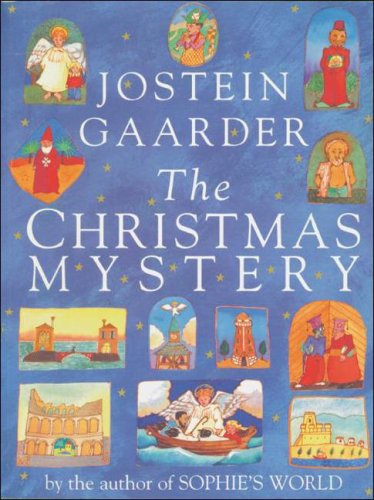
The Christmas Mystery: Gaarder, Jostein: 9781559213950: Amazon.com: BooksFinally, I'm currently on Day 7 of The Christmas Mystery by Jostein Gaarder.  This one's not a picture book, though it does have lovely chapter illustrations by Rosemary Wells, whose style I recognized immediately from the Max and Ruby and Yoko books. In a little bookshop in Norway, Joachim discovers an old advent calendar label "Magic Advent Calendar." Each day when he opens a door he's thrown into the story of another child - a little girl from 50 year ago.  In the company of an angel, a lamb, a shepherd and likely other characters I haven't learned of yet, a little girl named Elisabeth is running backward in time and space to the stable in Bethlehem where Jesus was born. 

I love a story within a story. I love a little magical realism.  I love fiction that takes faith seriously. And I love that at this moment there isn't much that interests both my teen and my six-year-old but so far they're both into it!  The chapters are short, fun to read aloud, and I could totally see this becoming an Advent tradition in our household.  One that's way better than chocolate - however fairly traded it is.  I offer gratitude and appreciation to Cindy Spencer for introducing me to this one. 

A blessing on your Advent reading and other activities.  

Monday, December 09, 2019

Comfort Y'all, My People


The following was my brief reflection in response to the theme question of our Advent season at SMC: "What are we waiting for?" and the theme word, "Comfort" drawn from the the text, Isaiah 40:1-11.  It wasn't quite the sermon, but it has a lot of sermon qualities.
--
Like, me, I’m sure that many of you, when you hear the text of Isaiah 40, “Comfort, O Comfort my people” hear music in their heads, whether that’s, "Comfort, comfort O my people, speak of peace now says our God,” or the much more tricky, “Comfort ye, my people” from Handel's messiah, followed by the warble of “every va-a-lley sha-all be exa-alted” I’m sure we hear and sing this text more than we read the scripture from prophet Isaiah. Especially at this time of year. Especially if you, like me, have ever spent any time in a choir.

But these words were prophecy before they were set to music for Christmas, long before there was a Christ or Christmas to celebrate. These were words spoken to a people who had been in exile for a generation or more. People who had been through some stuff - seen their city and homes destroyed, been taken into exile, wondered if God cared for them - whether God was even there any more.

And here comes the prophet with the words of God. Not, “Take comfort” not, “I comfort you,” but, “Comfort my people.” Or, as the tenor sings, “Comfort ye my people.” (Not, as apparently some people grew up hearing, “Come for tea, my people.”) In any case, these are instructions. Plural instructions. So who is God talking to? There’s some consensus in the academic community that God is speaking to the divine counsel. Speaking to the community of heaven to get out there and let the people of Israel know that this is it. Their wait is over, their deliverance is at hand.

Indeed we see later in the writings of Isaiah that the Persian king Cyrus will restore the exile to home and land and temple. Making a way through the hills and valleys of the wilderness. But at the moment of this prophecy that is still to come and God is speaking - possibly to other divine beings. But maybe God’s instructions to be comforters are for the very people who are in need of comfort.

As a Canadian I grew up thinking of the word/phrase “y’all” as a very American, very southern expression. Maybe still (?) that’s the impression. Certainly it’s not Canadian in usage - some Ontarians say ‘yous’ in a similar way. But I’ve started to find y’all handy. As I try to be at least somewhat more gender neutral in my language, I’m using “y’all” instead of “you guys” to indicate a plural “you.” Also, now that I’m a passport-carrying American citizen I feel I can rightfully adopt it as the language of my new people.

I think this right here is a “y’all” situation. God is saying, not “Comfort ye,” (or even "Come for tea") but “Comfort y’all, my people.” You, God is saying, you all are a people who have been through some stuff and you are in need of comforting. You have experienced loss and trauma and you need to be consoled. But also, y’all, you’ve seen and experienced some stuff so you know how to offer comfort to each other. Be comfort and consolation for your kindred. Offer care where you know care is needed. You know better than anyone how to do it.

I believe these instructions might be the encouragement to God’s people to keep on keeping on as a community who supports and consoles each other through trauma and loss. We can receive it as encouragement as well. Any community that experiences loss and goes through some stuff - which is to say basically every community, y’all be there for each other. Show up for each other. Care for each other. Pray for each other and hold each other. What are you waiting for? Comfort y’all, my people.
--

Photo by Rosie Fraser on Unsplash

Wednesday, November 20, 2019

Advent is Here!

candles in the dark against a backdrop of unfocused twinkly lights

Hey folks. Advent is around the corner! And thanks goodness. Orie has been asking me LITERALLY EVERY MORNING for the past week if today is Christmas. It didn't help that my mom sent a package for the kids to open to get ready for Advent - I mean come on! At least when Advent starts the calendars will be a vehicle for counting the days. Yikes!

So here we go. Below are some new and some tried-and-true Advent ideas for you to take a look at. And maybe try! I would love to know what your traditions and family practices are related to this season of waiting for Jesus.

Chocolate Calendar - Divine Chocolate is my go-to treat-based advent calendar both because it's fair trade chocolate and because there's a little bit of the Christmas story in each window. I just went ahead and got one for everyone in my family because then no one gets left out. I chose the dark chocolate version for myself.

Do-It-Yourself Nativity - This Paper Nativity by could be printed and put together each day of advent little by little. Or just all at once as an activity. And if you're feeling creative, you could make your own or have kids make different pieces of it.

Tiny Image and Devotions: Thomas Mousin's tiny devotions calendar is a down-loadable one-page calendar with a brief verse and mini-picture for each day. In this years (he does one each year) you need to do a little searching to find each day. Could be colored in as the days go by, or just used as a prompt for reflection and conversation.

Praying in Color: In a similar vein, Sybil McBeth at Praying in Color does a new Advent fill-in-with-color calendar each year, which is more free form and person/child directed. I've sometimes done this myself as a little personal devotion for Lent or Advent and value the few minutes of mental space it creates. Explore the website to learn more about how to pray in color if you get stuck.

Advent Word: For the more online-inclined, join others around the globe through #AdventWord, an online advent calendar which chooses a focal word each day and encourages followers to post their own reflections, images and prayers inspired by that word and share with other followers through social media platforms. More at adventword.org or by searching #adventword on social media. I did something similar to this once on instagram and often see others doing so. It's fun to see what the different words inspire.

The 99c Advent Wreath - I am skeptical this this will really be 99 cents, but the supplies include glitter, modeling clay and birthday candles, so it's definitely affordable. Children can create it themselves and if each child in a family has their own, perhaps the competition over who gets to light/blow out the candle will be eliminated (my hope, anyway).

Living Advent Wreath - this wreath made of actual children pretending to be candles is probably not something any of us are going to do at home - I just thought it was a really cute idea. Maybe we can figure out a way to do this in worship some year.

Advent Devotions - Common Word, a resource from Mennonite Church Canada creates a family-friendly downloadable advent resource. This seems like it could be used daily or occasionally or weekly, whatever works for your family. This year it's called, "Waiting and Wondering"

Saturday, December 19, 2015

Bible Bechdel


By now the Bechdel test is a pretty familiar way to evaluate whether a movie or book is good for women.  Or at least is measures the presence of women in a simple test: There are two women with names who have a conversation about something other than a man.  I wondered about this test as I prepared to preach on Mary and Elizabeth.  I have made it my business to know women's stories in the Bible and there are many women whose stories are inspiring or heartbreaking, who were integral to the arc of the narrative.  But there were not so many women across the Bible who had relationships with other women un-related to men.  

The Bible is a product of it's cultural context and we get to hear a lot about men and all the stuff they say and do.   Frankly, maybe I should be a little surprised that there are any women in there at all.  As it happens the Luke story of Mary and Elizabeth just barely passes because the conversation has to do with the boy babies in utero.  Thanks to Google I didn't have to scan scripture myself.  (I appreciated both the post and the comments from this blogger).  There are only three.  Four if you stretch it to the apocrypha:


Ruth 1:8-17, 2:2.
Mark 16:3
Luke 1:42
Tobit 7:16

Ruth is a favorite of mine (I did name my daughter for one of the two women therein) and while ultimately Ruth and Naomi's goal is to get Ruth re-married, their relationship to each other is central.  In Mark the women at Jesus tomb discuss the problem of the stone in their way.  Mary and Elizabeth in Luke, and in Tobit a mother giving her daughter advice on her wedding day.  That's it!  


Wednesday, November 25, 2015

Christmas Tree Blessing

I've really enjoyed Traci Smith's Seamless Faith for it's everyday suggestions about how to incorporated conversations and easy rituals into family life. The following is a seasonal example as we approach Advent and the annual installation of Christmas decorating:
----
This tradition allows families to bring a moment of spirituality to the secular tradition of decorating the tree. Try having a different family member read the blessing each year.

Designed for All Ages

Time Investment: 1-2 minutes

Materials:

1. Blessing (printed below)

2. Christmas tree (before decorating)

3. Manger scene/crèche scene (optional)

How To:

1. Before the tree is decorated, gather everyone together around and read the following blessing:

God who created the bird in the air, the fish in the sea, the stars in the sky, and the trees in the ground, bless this tree as we decorate it and make it a joyful symbol in our home. May its branches remind us of the shade and shelter you provide for us and for many creatures. May its trunk remind us of your strength. May its light bring us peace. May we remember your gift to us this season, the gift of the baby Jesus. Amen.

2. Optional (see note below) – After decorating the tree, set up crèche or manger scene below the tree.

Note:

In the United States there seems to be a sharp division between secular Christmas traditions (the tree, the stockings, Santa) and Christian traditions (the manger scene, attending church, singing Christmas carols). As the tree is the focal point in many homes during Christmas, blessing the tree and setting up a manger scene under the tree (as opposed to gifts) can highlight the Christian significance of the day, something culture has lost sight of.

Variations:

· Print the blessing on an ornament and say it as the ornament is hung on the tree.

· Write a new blessing each year and collect them from year to year.

· Cut down your own tree and say this blessing before the tree is cut down and brought home.

· Adapt the language of the blessing to the age of your children or your own traditions and culture.

Monday, December 22, 2014

Favor > Fear

“Glory to God in high heaven,
and on earth peace to those on whom God’s favor rests.”
              - Luke 2:14, The Inclusive Bible

When I was ordained I was invited to choose the texts that would be read and preached in the worship service. I chose two: Mary’s song – the Magnificat – and Jesus’s proclamation from the scroll of Isaiah. It was the beginning of his public ministry. I chose these both because of their content – the declaration of God’s just reign – and because they both marked no-turning-back points of change for the speakers, mother and son. They seemed appropriate to the moment of ordination to ministry.

During the ordination service, David Morrow, who was then our District Pastor, preached these texts and revealed what I had not seen in them. They have in common the declaration and celebration of God’s favor. In fact, references to God’s favor are threaded throughout the first part of Luke. Elizabeth, Mary, Zechariah, the angels and then Jesus himself declare or are recipients of God’s favor.

In many of these stories, fear is a companion of favor. Angels telling their audience not to fear, people boing fearful of what God is doing in their midst. Favor does not by any means have anything to do with respite or safety or privilege. What has become clear to me after reading Luke’s take on ‘favor,’ or charis in Greek, is that God is not doing anyone any favors by bestowing this favor upon them. In fact favor is where the trouble begins.

Just for starters: the child of Elizabeth and Zechariah becomes the prophet to makes way for Jesus, cruelly beheaded because of conflict with a corrupt monarchy. Mary’s song declares that God’s favor rests on the lowly, poor and hungry, but she’s still one of an occupied people (never mind being a pregnant, unwed teen). The song of the angels declares that peace will be for those on whom God’s favor rests – people like those very folks - terrified, occupied, lowly and watching their sheep on a hill.

But the thing about favor is, that where there is fear there is also praising and glorifying God. The shepherds were amazed and they returned from their encounter with the holy family praising! They wanted to tell it on the mountain. They wanted to spread the good news. With the declaration of and living into being favored, there is a mighty hope that the lowly will be lifted up, that the hungry will be fed. Those who accept God’s favor head right into that trouble because a trouble like that is a trouble the favored want to be a part of.

The baby whom the angels announce to the shepherds, when he first called out the year of the Lord’s favor in his Nazareth synagogue, that sounded pretty good to the people who were listening to him. Until he went one step further to talk about the love of God demonstrated to Gentiles and almost got himself thrown off a cliff. Later, well into his ministry of healing, Jesus raises a widow’s son in Nain and the first thing we hear of is fear! “Fear seized all of them; and they glorified God, saying, ‘A great prophet has risen among us!’ and ‘God has looked favorably on his people!’”

Fear and favor and glory to God are all mixed up together with the prophetic and prophesied action of Jesus – healing, preaching, calling disciples. Being favored by God is indeed a fearful thing. It is also a wonderful and joyful engagement with the reign of God. It is singing with Mary and the angels and preaching and healing with Jesus. Favor is greater than fear – far greater. May we give Glory to God in high heaven and may peace be upon those of us who rush head-long into God’s favor. No turning back.

This blog will be cross posted Christmas Day at Advent:Healing and Hope

Wednesday, December 10, 2014

A (Mostly) White Congregation and Conversations about Race


We are a (mostly) white congregation.  Individually and as a group we have for the most part been insulated from experiences of discrimination, violence or even the ‘micro-aggressions’ which face people of color face regularly.  I’m encouraged that we are trying to raise our awareness of this in a variety of ways, including our recent worship series on the Doctrine of Discovery and how the last 500 years in its wake have led Europeans and their descendants to treat all non-white persons and the lands on which they’ve lived as individuals and spaces to be either colonized, subjugated or ‘civilized’ by any means necessary.  Although the Doctrine of Discovery is no longer something the majority of the population knows about, its impact continues to be lived and experienced both by people of color and by white folks.

The violence against African Americans by police in high profile events recently and the subsequent vigils, protests and campaigns for justice are a result of the last half millennia of this subjugation and internalized understanding of who we are in relation to each other.  I am left wondering about a) how to talk about these events, about this injustice with my child and b)how to respond and enact a lived justice that I believe I’m called to.

During the Loss of Turtle Island exercise, I experienced the visceral grief of my child when she learned about the way white settler Christian soldiers knowingly and systematically gave small pox blankets to indigenous people in order to infect (and kill) them.  We have taught our children that God loves everyone and that Jesus came to show God’s love to the whole world.  It is easy to believe this when your family looks like mine does - white, hetero-parented, middle class, educated - and our experience is not one of discrimination.

When confronted by the horrible injustice of small pox blankets, or of white police officers who are seemingly free to do violence to black people, the reality of the world collides with the reality of God’s world, that is the kin-dom which we are trying to teach our children is here and which we are a part of.  There is a collision and somehow at the same time a disconnect with what we – and God – long for and what is.

A couple weeks ago I shared an article by Peggy McIntosh about the ‘invisible backpack’ of white privilege.  The invisible backpack is all the ways that I don’t even realize that I benefit from systems that prefer light over dark skin, from knowing that I’ll be able to find books with characters that reflect me to not having to question whether the non-response to my resume was because of an ‘ethnic’ name.  Because of my own hope live in a community that is not all just like me, our family made a choice to live in a diverse neighborhood and enroll in a school that is highly diverse.  Our school is intentional about teaching respect for a multiplicity of cultures, focuses on peace heroes as a part of its yearly curriculum and approaches history from a variety of perspectives.  Right now a song about Rosa Parks and the bus boycott is being sung at my house and I am amazed and grateful.

I am also very aware of Peggy McIntosh’s point that even in this diverse school, I can count on most of my child’s teachers – even those who are teaching immersion Spanish – to looking like her.  I wonder what it’s like for a native Spanish speaking family from Mexico or El Salvador to have their child taught in Spanish by a blond, blue-eyed American.  In a way that her peers are not, my daughter can be blithely unaware of her color and even of theirs.  It takes me actively engaging the question of how I look different than many of my neighbors and may be treated differently because of it to raise that kind of awareness. 

That’s where I’m starting for now.  I’m not going out of my way to start conversations about Ferguson or about death, but sometimes I do encourage noticing.  When we’re reading a book about Ruby Bridges, I ask, what did you learn about Ruby?  Why do you think those people were so angry?  And when I’m asked questions about how I feel and why I try to be honest.  Here’s an approximation of a conversation that happened at my house last week.
“Mama, why were you crying at church this morning?” 
“Well, I was sad and frustrated.  In summer a young man who was black was shot by a police officer who was white and we found out this week that it doesn’t seem like there are going to be any consequences for the police officer.”
“Did he die?”
“Yes, he was shot and he died.”
“That’s not fair.  We’re not supposed to use guns.  He shouldn’t have done that.”
“You’re right.  It’s really not fair.  It’s also not fair that people who have white skin like us get treated different – better – than people who have brown skin like the person who was killed.  And that’s why I’m so sad and frustrated.”
We have often talked about guns in our family as not being okay.  We stress that Jesus wants us to be peace makers.  Why do the police have guns and but other people aren’t allowed to?  Not a question I can answer to my own satisfaction.
                                                                                                                                  
I am still sad and frustrated.  But I’m also determined to continue to re-examine my own attitudes, to listen to the experiences of people of color, and for the most part to keep my own mouth shut when in the context of people are sharing their experiences and to encourage other white people to do the same.  It’s not my experience that the world needs to hear.  For those of you in our congregation who identify as people of color, I am grateful for you and that you continue to walk with this congregation. I think a lot of what I can do is about acknowledging the power and privilege that I have and letting those who are giving voice to experience of discrimination or violence speak and, if I can, amplifying their voices.  That’s why I’ll be wearing black in worship this week at the invitation of Christian leaders and congregations of color to be in solidarity with the message, "Black lives matter."

I trust in the God, in whose image we are all made.  I trust that God is walking with the pray-ers and protesters and who is grieving with those who grieve.  I trust that God’s dream is for a kin-dom in which we are not blind to color but that we see it and value it.  When we are wearing black to proclaim that black lives matter, may we more and more internalize what we proclaim, that God’s dream may be realized.

Wednesday, November 26, 2014

After Ferguson: Talking to our Kids about Privilege


If you are on Facebook, I’m sure that your feed yesterday and today has been full of #ferguson.  If yours is like mine it is with disappointment, rage and disgust as well as prayer, cries for justice and ideas about action.  Within myself I feel those things and more.  Even as we finish a worship series that highlights our privilege with relation to the first peoples of the nation, we hear news that highlights our white privilege with relation to our brown and black neighbors in our nation.  I weep.  I mourn.  I wonder, ‘How long, O Lord?’

As I think about what else I might offer of my own thoughts on this, I’d like to pass along a couple resources I found helpful in thinking about my own privilege, which may help others in talking to children (or adults) about ways that those of us who are pale or pink benefit from our pigmentation without even thinking about it.  There’s plenty out there on the internet for you to find, but I found a good starting place for concrete examples to be Peggy McIntosh’s 1988 work on the ‘Invisible Backpack’ of white privilege.  Although the article was written almost 25 years ago, her list of ways that white privilege is experienced in ways small and large is a helpful starting place for noticing for ourselves and with our children when we unthinkingly benefit by not even having to think about how we move about in the world. 

This week I was particularly struck that “I do not have to educate my children to be aware of systemic racism for their own daily physical protection.”  And yet many do, including some of our friends, neighbors and the brothers and sisters in Christ who worship with us.  Inviting our children and opening our own eyes to notice is a first step to recognizing our experience – whether it’s the realization that the Bandaid I pull from the box will most likely match my skin or knowing that I will not have to look far to find children’s books which have characters who look pretty much like me and my children. 

For a plethora of resources on teaching children about race, privilege and Ferguson, The Atlantic put together a long list of articles, videos, books for children and adults, poetry, even ‘educational hashtags’.  And The Root has a short but helpful set of ‘Do’s and Don’t’s’ for teaching and talking about Ferguson with children and youth.

As we begin this season on Advent, may we do so with confession, action and hope.  May we challenge the Thanksgiving and Christmas narratives that make pale faces the center of the story.  May the many-hued face God shine on us and be gracious to us and may the presence of God give us peace as we despair, as we rage, as we pray, as we act.

Wednesday, December 28, 2011

Advent Vignettes

Costumed children rehearse in front of a cardboard barn and lighted star. Fits of giggling interrupt the serious scene when they made mistakes or their nerves show. A patient director (the writer of the play) laughs along and their heads bend in together to hear instruction and encouragement.

'Angels' receive their tinsel halos, jostling and making faces as they wait for their turn. Later they will share their crayons as they look up at their senior friends acting out a Christmas narrative.

A banner adorned with the fourth Advent candle walks across the sanctuary carried on long poles. It will be carefully raised to join it's sisters high on the walls, surrounded by watching and guiding hands and eyes.

Fingers on a sound board test levels and prepare microphones.

Tables are erected and laden with paper, glue and scissors, beads, foil and string, cookies and frosting. A celebration of sugar and creativity will be feasted on in this space.

People come in from the chill to bright poinsettias and hot coffee. All around hugs and greetings and laughter are shared.

In that moment, the Advent of Christ was palpable. We were waiting. We were preparing. We were making ready for worship and fellowship and for God-with-us. The anticipation joy was everywhere. And now, as we anticipate the new year I pray for my beloved Seattle Mennonite family that the joy may be sustained. May the potential energy of Advent be know in fulness as we live into 2012.

Thursday, March 01, 2007

Knocked Up Like Mary

This year in advent I sat through a sermon about Mary and Elizabeth that was preached by a man, all the time thinking, 'that should be me preaching this sermon.' It had never bothered me before. Last year during advent I had been so frustrated with the birth imagery, the reminders in the daily devotion (for women) that I was doing that for women creativity is like birth. Even then, a little over a year ago, I still felt very ambiguous about giving birth and about my own role in bring new life into a crazy mixed up world.

And then I got pregnant. It's not that I don't have doubts about the presumption of bringing yet another human life into an already busting-out planet. Nor do I have complete confidence in my ability to raise and nurture a strong and confident daughter in a world that is still so misogynistic in many ways. But I also now realize that all those things people say about the miracle of pregnancy, and the hope of childbearing is true.

My openness to bringing my daughter into the world speaks to my hope both for her and in what God can do here. And her growing in me makes me constantly amazed at the actual fully unique human being that God is creating inside. In spite of my worries about the future, the tension I feel about being a parent, I cannot wait to meet my baby, to discover how she is like me and my husband, to see how she is totally her own person, to get to know her. And there she is in me, two months away from coming into the world and it is an indescribably feeling and joy every time she moves - even when it's in the direction of my already squeezed bladder.

I hear the Luke passages about Mary and Elizabeth and the babies jumping in their wombs in a whole new way. Jesus was just like the baby growing in me, and that blows my mind. God's greatest hope for the salvation of the world was just like my own daughter.