Showing posts with label God. Show all posts

Wednesday, October 27, 2021

Listen Past the Noise


This week in worship, the text from the narrative lectionary is the story of Elijah, who goes up on Mt Horeb to encounter God. He experiences an earthquake and a fierce wind and great fire. God isn't in any of those noisy and mighty phenomena. Instead, God come to Elijah in a "still, small voice" (KJV) or "a sound. Thin. Quiet" (CEB) or "the sound of sheer silence." (NRSV) While each of these versions translates the experience differently, it's clear that though sometimes God does who up with great force, this time Elijah needed to listen very closely and careful to hear God speaking.

In the time with children I'll be featuring Gabi Snyder's book Listen, which invites readers to "Listen past the noise." I love the way this book illustrates the practice of mindfulness and attentiveness. From the moment the featured character steps out of her house into the "big, wild world," she's surrounded by noise: barking dogs, honking cars, zooming motorbikes. She closes her eyes. "What if you stop... and listen? Can you hear each sound?" the book asks. She keeps noticing: not just the thump-thump of jump ropes and the crunch of gravel, but words of delight and hurt spoken by friends and classmates.

The care with which Gabi Snyder invites her readers to attend to the world around them reminds me of the mindfulness practice of noticing with the senses. Take a minutes to notice:
- 5 things you can see
- 4 things you can hear
- 3 things you feel
- 2 things you can smell
- 1 thing you can taste.
As I close my eyes now in my office and listen, I hear banging and clanging from the construction site across the parking lot, the click-clack of keys in Lee's office next door and the quiet hum of the florescent light above my head. Slowing down long enough to hear those things also slows and deepens by breathing and helps me be more aware of my own body and heart.

This book does that too. The girl is able to hear many sounds, but she also listens past the noise, and then past the silence. She hears the sounds of her body, the sounds of her feelings. The author asks children to think about what they hear when they listen to the quiet. The whoosh of breath? The voice inside?

In our understanding of the way God speaks, sometimes that tiny voice inside is a hint of God speaking. And until we quiet ourselves enough to hear, we just won't. The still, quiet space we make for ourselves can also make space for God or for our understanding of God within to grow.

You can find this book at the library or buy it from a local bookshop. But a quick cheat is to find it on YouTube and either listen to reader or pause and click through the pages read it yourself. The best one I found for pictures is here. For more book on mindfulness and careful listening I suggest the Susan Verde and Peter Reynolds "I Am..." book series, especially I Am Peace. I also like Breathing Makes it Better: a Book for Sad Days, Mad Days, Glad Days, and All the Feelings In-between. by Christopher Willard and Wendy O'Leary.

I'd love to hear what you heard when you listened. Or what practices help you and your family make space for the still, small voice of God.
--
Photo by Pelageia Zelenina from Pexels

Wednesday, October 28, 2020

A Hot Holy Mess


When Megan talked in her sermon this past Sunday about Hannah's hot, holy mess of a life, which she brings before God in prayer, I thought, "Yup, sounds about right." The hot mess part, anyway. It doesn't much feel holy. 
 
Last week you didn't get a Midweek Message from me because of the hot mess of the Epp Hamilton household, including: very noisy window construction/replacement (also a literal mess), two full-time working adults and children doing online school, one of whom needs constant oversight, a COVID scare, which turned out to probably be Norovirus, but which was still very unpleasant, and the increasingly dark and stormy weather. I'm not trying to complain or seek sympathy, I just want to say: Folks, I'm right there with you in the very messy middle of this pandemic.

At our recent meeting of the 'Discerning Returning Team' (increasingly this seems like a misnomer, since we're definitely not returning to gathered in-person worship any time soon) we acknowledged how difficult the labor of families with young children is at this time. Even when things are going pretty well, there is emotional labor we parents are doing constantly in caring for our own mental health and the mental health of your kids.

But even though last week was a really big bummer, I've had some lovely highlights in the past few weeks. Every year we gift our 3rd grade students with Bibles, recognizing that by this age they're good readers and critical thinkers and ready to have a Bible of their own. I visited with the 3rd grade families on front porches and in backyards and got to see what's up in their families and say hello to their pets. It was so lovely.

So yes, life is messy. So messy that it makes me want to (and sometimes causes me to) scream in frustration and helplessness. But in my more grounded moments I realize that God is right there with me. And you are there with me. And there are these beautiful bright spots in the midst of it: the brilliant red leaves on my neighbor's maple tree outside my new windows, long walks - with my kids and without them, finding I might be a dog person after all, and the hope of seeing more of your faces in the coming weeks.

All that is very holy - just filled with the Divine. I pray that you too find the holy in the mess of each day. I hope to see a few of your kids in Sunday school this Sunday for a story and game and to see how they're doing. If not, I look forward to seeing your faces in person.

Monday, June 01, 2020

Body Language

cirque du soleil acrobat

1 Corinthians 12:1-13

Friends! Not only do you get me preaching twice in a row, you once again get Paul talking body talk. Paul really does love the God-bod image. This time though, the body talk is in service of how each of the parts work together, how the community of Christ engages and interacts “For the common good” (as Paul puts it).

This is a Pentecost text because it is about the fullness of the Spirit’s action in the new church. The Spirit is actively filling the members of the church - at Corinth and in every place and time - with gifts to be “activated” in service of the church (and I would say also the world - but that’s me not Paul.) The gifts work together the way a body works together. And they can also work against each other.

When I was seeing a Quaker Spiritual director - someone steeped in the way of presence in Spirit - I was helped to see the spiritual gifts as innate. Our gifts are so a part of ourselves that our gifts become almost our native language. Like language and culture, we might more highly value our own than that of others because we can’t understand it. In addition, when we can’t understand someone else’s gift we may feel it unnecessary. That lack of understanding can be the cause of conflict and misunderstanding.

Language of Enneagram is not a language that I speak but I suspect that those of you who do may be able to translate this to type. I do not know that way of engaging in giftedness but i do have a little bit of insight into love languages. The idea of “Love Languages” was developed by psychologist Gary Chapman and I was introduced to it in couples counseling as a way to help my spouse and me to understand each other and communicate. Each of us has a different “Love language”: Words of affirmation, physical touch, receiving gifts, quality time, acts of service. When we’re “spoken to” in that language we feel loved and connected to our partner.

For example, my primary love language is “acts of service” but my spouse’s is words of affirmation. So we often talk past each other when trying to express our love and appreciation. I’m looking for someone to do the dishes after dinner - that says love to me. I don’t necessarily hear “I love you” in the expressions of gratitude and affirmation for a delicious meal. But also because words of affirmation are not my love language - I forget to articulate my own appreciation and encouragement and gratitude, which is how my spouse feels loved.

This is the passage that leads into the loooove passage to the Corinthians. The one we heard a few weeks ago. Even though we’re not hearing them in order, it seem right that this should be the first step. Before we can learn to love each other - need to speak each other's language - or at least have an appreciation for that language. Someone who does not speak the spiritual gift of prophecy, might find that gift to the church annoying or distracting or troublemaking. But prophecy - the telling of truth to power and naming injustice pushes the church body to be more Christ-like. The body will communicate between its members more fluidly if the hand is learning the language of the eye.

Many years ago I saw a Cirque du Soleil show in which I spent almost all of the show with my mouth agape and gasping in awe at the way the acrobats and dancers engaged their whole bodies in the performance - and at how their bodies worked in concert with each other. Even the musicians and the clowns. There was no part that was not used with intention and beauty and strength and grace. But it takes a lot of training and practice for one of those acrobats to be able to do that - for anyone who is an elite athlete to be able to make their body work in the way that it does. It takes practice for the Body of Christ as well.

This isn’t the usual Pentecost passage. We’re used to focusing on the rush of wind and the tongues of flame. On the crowd, which through the power of the Spirit can understand their kindred from all nations. Here we see that the Spirit continues to give language and the understanding of languages to the church. Paul is extending that into metaphor, in a way. It’s not just gifts that are being doled out, it’s Spiritual gifts. And all the Spirit’s gifts are good, resources that are for the good of the whole body. May we seek to listen for and to understand the language of the Spirit - and in so doing may we strengthen the body.
Turns out I wrote a sermon this week that I didn't end up using because the Spirit called me in a different direction (more on that in a later post, perhaps).  But here's the text of the sermon that would have been...

Thursday, September 19, 2019

Just Keep Breathin'

There's plenty of pop music that make me roll my eyes or straight up gag (I do not love it when you call me senorita). But always like it when Ariana Grande's song breathin comes on the radio. Sure, it's a little repetitive, but the woman is handing out some pretty good advice, honestly. Ariana sounds like she might be living with anxiety, frankly. I hope she has a good therapist. But maybe, like me, she is just stressed out. I've been stressed out, friends. I admit it. Pastor Megan's absence left me with more on my plate than I'm used to and I'm starting to feel it.

A couple weeks ago when we blessed our kids' backpacks for school and all our totes and bags with the assurance that God breathes within us. I even preached this whole sermon about breath and feeling the breath of God give life. Sigh. Sigh again. Seriously, that's how I'm breathing these days. Held breath and sighs. I'm having to remind myself of my own and Ariana's advice constantly.

With adults - and even teens and tweens - sometimes we can offer a simple reminder: 'Remember to breathe!' or 'Let's take a deep breath,' when we notice stress being held in the body. Helping younger kids to breathe when they're feeling stressed or anxious isn't always that easy. For one, who likes being told what to do? Second, it might seem counter intuitive, but I think we actually need to be taught how to breathe. I have a couple go-to methods for breathing and focus and mindfulness that I come back to. And I recently found one that I'm adding to the list.
1) Balloon - take a deep breath like you're going to blow up a big balloon. Form a small round balloon shape with your hands by your pursed lips (they're around the balloon's opening) and blow out, watching your hands grow larger. Do this again a few times until the balloon is the size of your open arms. Then let the balloon go up into the air. (I know: the balloon isn't knotted and full of helium; just go with it.) 
2) Birthday Cake - pretend you have a birthday cake full of candles in front of you. (You're really old, I guess). Take a deep breath and blow like you're blowing them out. Count aloud with your child or have them count in their head - how many candles did you blow out? 
3) Snake Breath - I is the new one got this one off of this resource from Barefoot Books. "When they are coiled and resting, snakes look around calmly, and when they are ready to move, they are slow and smooth. Sit up tall. Take a deep breath in, filling up your whole body. Pause and breathe out slowly and smoothly, making a hissing sound for as long as you can. Repeat for three to five rounds, feeling yourself slow down and become calmer each time."
Breathe, everyone. And then keep breathin'. The God of life breathes in you, in your kids, and in me too!

Wednesday, May 08, 2019

For Mothering

In honor of Mother's Day this Sunday, I offer a song, a prayer and a reminder.

The 23rd Psalm
First, I again share with you this masterpiece by Bobby McFarrin. Maybe I'll share it every year. It's so good!

A Prayer for all Kinds of Mothering
Second, this Mothers Day blessing adapted from a prayer that was shared around social media a couple years ago and which I found posted by Sarah Bessey on facebook, based on a post by Amy Young here.

May you know the blessing of a mothering God...
if you are like Tamar, struggling with infertility, or a miscarriage.

if you are like Rachel, counting the women among your family and friends who year by year and month by month get pregnant, while you wait.

if you are like Naomi, and have known the bitter sting of a child's death.

if you are like Joseph and Benjamin, and your mother has died.

if your relationship with your mother was marked by trauma, abuse, or abandonment, or she just couldn't parent you the way you needed.

if you've been like Moses' mother and put a child up for adoption, trusting another family to love your child into adulthood.

if you've been like Pharaoh's daughter, called to love children whom you did not bear.

if you, like many, are watching (or have watched) your mother age, and disappear into the long goodbye of dementia.

if you, like Mary, are pregnant for the very first time and waiting breathlessly for the miracle of your first child.

if like Hagar, now you are mothering alone.

if motherhood is your greatest joy and toughest struggle all rolled into one.

if you are watching your child battle substance abuse, a public legal situation, mental illness, or another situation which you can merely watch unfold.

if you like so many women before you do not wish to be a mother, are not married, or in so many other ways do not fit into societal norms.

I want you to know that I am praying for you if you see yourself reflected in all, or none of these stories.

You are loved. You are seen. You are worthy.

And may you know the deep love without end of our big, wild, beautiful God who is the very best example of a parent that we know.


Mothers for Peace
And finally, if you are still reading, a reminder. The origins of Mother's Day was the intention that it be a day for peace an unity. It's creator was Ann Jarvis who wanted to continue the work of and honor her own mother, who had witnessed the devastation of the American Civil War and worked to heal bodies, spirits and communities broken by it. Ann was joined in her campaign to have Mother's Day recognized as a national holiday by suffragette Julia Ward Howe who wrote the "Mother's Day Proclamation" including this memorable quote:

“Our sons shall not be taken from us to unlearn all that we have been able to teach them of charity, mercy and patience. We women of one country will be too tender of those of another country to allow our sons to be trained to injure theirs.”

From the bosom of the devastated earth a voice goes up with our own. It says, “Disarm, disarm! The sword is not the balance of justice.” Blood does not wipe out dishonor nor violence indicate possession.


Happy Mothers' Day. In the name of the one God who mothers us all.

Wednesday, May 09, 2018

One God Who Mothers Us All


One of my preferred ways of speaking the trinitarian formula is this:
     In the name of the Father
     and of the Son
     and of the Holy Spirit
     One God who is Mother of us all.

This is a favorite now but but when I first began to imagine God as Mother it felt really weird.  It made me feel squirmy and wrong when, in my prayers I began to experiment with female images.  I think this may be the case of many of us who grew up in traditional churches.  It's likely true even in non-church culture, where 'the man upstairs' is universally understood to mean God and with a couple of notable exceptions (Alanis Morrisette or Octavia Spencer for example) God has been portrayed in most art and media as an old white, bearded dude in the clouds.

Yet mothering imagery for God - even for Christ - has ancient roots.  These are words from Julian of Norwich in the 14th century (and from our Hymnal #482):
     Mothering Christ, you took my form,
     offering me your food of light,
     grain of life, and grape of love
     your very body for my peace.
Who else but a mother feeds and nourishes and sustains her children from her very body?  This Christ-like action that we all experience when we share at Christ's table and that I understood in a new way as a nursing mother.

And way, waaay before Julian, the Biblical writers understood the mother-ness of God, although we haven't always read it that way.  Hosea writes in the voice God: 
     
I taught Ephraim to walk, I took them up in my arms;
     yet they did not know that I healed them.
     I pulled them along with humane restraint, with ties of love.
     And I was to them like those who lift babies to their cheeks,
     I reached to them and fed them.
Sure, dads can do that stuff too (thanks be to God).  But for the prophet and the culture and context in which he wrote, he was imagining the Mother.

When I was in college and spent a summer as a camp counselor in Alberta, I butted heads often over theological issues with a particular counselor who was much more conservative than I.  But I found on the matter of gendered God language he was completely on board with Mother God.  For him it was a matter of having had a father who was emotionally and sometimes physically abusive, who was anything but the nurturing and tender parent that we long for in the God.  To imagine God as Loving Father was painful and difficult and difficult for him, when for me it was comforting and tender because I have a dad who was comforting and tender.  Hosea's image could easily have been Father in my eyes, just as it has so often been understood by so many.

The naming and understanding of God is going to be as nuanced as the ones who name and call on Her.  For those of us who parent, we can understanding a parenting God through the lens of our experience of parenting. Calling on Mothering God can be meaningful both in our experience of mothering and in our longing for one who provides the comfort and tenderness of a mother's arms in our time of need when nothing will do but Mama.

Finally, if you have not heard it before (or even if you have!) I recommend Bobby McFerrin's adaptation of the 23rd Psalm.  His hymn of praise to God our Mother is transporting.  You should put it in your ears RIGHT NOW.  Happy Mother's Day all you who mother, who have mothers or who need our Heavenly Mother to give you rest.
__
Image of Julian of Norwich by Br. Robert Lenz.  Click on it to learn more about Julian (and her cat).
Image of hands by Jon Warren, taken about 10 years ago of my hands with my daughter.

Wednesday, May 02, 2018

For the Love of Camp

Camp Shekinah, approx 1989
When I was a child, my Mennonite camp was called Camp Shekinah. It’s in the valley cut out of the prairie by North Saskatchewan river, which in some summers a trickle and some summers floods the banks as far as the lodge, but most summers is somewhere in between. Which always provides ample breeding ground for mosquitoes. It's the camp where I learned to canoe, tie knots, use a compass and build an excellent log-cabin or a-frame fire. It's also where I re-enacted the Exodus, learned the definition of the word 'statutes' (it's not the same as statues), had a counselor talk to me about why he got baptized and where I began to understand that following Jesus would be my choice too.

I loved camp. I could not wait to say goodbye to my parents and find the friends that I'd made the year before. I felt like I belonged there in a way that I didn't experience in other parts of my life and it fed my soul. That is the experience I long for every child to have when they go to camp. I see it now at Camp Camrec when I go as a staff person. The space might be different, but the essence is remarkably similar: the beauty of creation all around, children and youth invited into the work of God in the world, the joy of connecting with caring community, songs and stories and worship around the campfire.

My childhood camp isn't the 'Camp Shekinah' of the canvas tents and mud trails anymore. It's Shekinah Retreat Centre whose facilities have grown (past the flood line) and whose program is year-round. I've visited a few times in recent years and because my cousin was the program manager I even got to experience the new zip line. But the kids that I observed who were there as campers were still having essentially the same experience that I had, that kids at Mennonite camps all over the continent are having - a fun, meaningful, holy time of learning and connection.

I'm looking forward to being at camp again this summer with the older youth. I hope your families too will take advantage of the opportunities it offers. Registration is open.  :)

Wednesday, May 18, 2016

You Can't Wear God...Unless You Can

"You can't wear God."

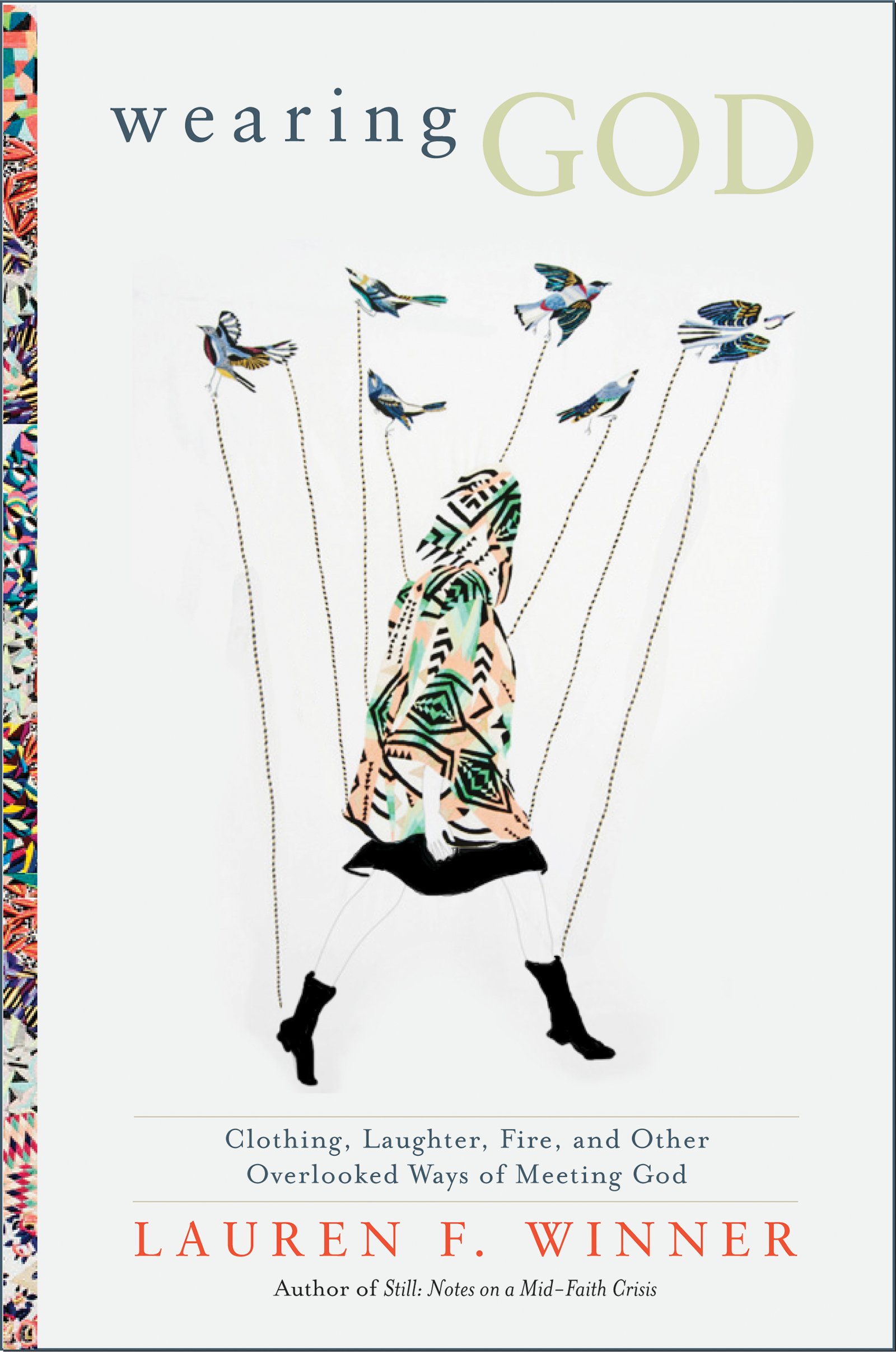
Lauren Winner's book, titled Wearing God, was dismissed out of hand by the nine-year-old in the back seat, where the book had been languishing for several months.  (I started it after hearing a presentation about faith and fashion by Clara Berg, child of my congregation and now the Collections Specialist for Costumes and Textiles at Seattle's MOHAI).  I had tossed the book back there after reading the chapter 'Clothing' and 'Laboring Woman' - the two metaphors I was most interested in and connected to my experience.

The idea that God is ready-to-wear should be no more surprising than God being our rock and foundation,* or the light for my path** or, for that matter, laboring woman.*** As it turns out metaphor is all we have for God, who is only knowable through human experience and language.  This is tricky for humans (perhaps especially young humans) who like nice concrete handles on which to hang ideas.  We want to know exactly who and where God is.  We like certainty to be tacked to the wall like a family photo so we can look at it and be reminded: ‘Oh that’s nice, there's my spouse, whom I love and who loves me and who is now at work just as I am at work and we'll see each other later.’  But God will not be tacked.  Metaphor is what connects God to our experience and helps us to understand and get a glimpse - even if it's a small one - of God's nature and being.  It helps us place God.

The nine-year-old should not have been surprised either, having recently learned about metaphors in third grade.  She knows that metaphors are not a thing themselves but are a comparison that describe an aspect of the thing.  In fact, she came up with God being like a cloud (to be fair: a simile, not a metaphor) when she was four!  We have read books and had conversations about God's many names.  At the point of the declaration, we had the conversation again.  I guess we all need reminders.

We need reminders that we can wear God, who is comforts us like an old sweater.  And we can dwell in God, who is our home.  And we can turn our faces to the warmth of God, who is our sun.  God the washing machine agitates us and starts us fresh. We experience and know God in a multitude of ways, many of which are in the Bible.  And because we are human and God is God, we can each determine the best metaphor for our own experience of God, in whose image (whatever that is) we are created.  What is yours?


“My God is my rock, in whom I take refuge, my shield and the horn of my salvation, my stronghold” Psalm 18:2
** “Your word is a lamp for my feet, a light on my path” Psalm 119:105
*** God: “For a long time I have held my peace, I have kept myself still and restrained myself; now I will cry out like a woman in labor, I will gasp and pant.” Isaiah 42:14

Wednesday, April 20, 2016

Marked with Love

John 13:34-35 is the lectionary text this week, but since we're doing a series on Acts, I won't get a chance to expand on this very valuable analogy.
I give you a new commandment, that you love one another. Just as I have loved you, you also should love one another. By this everyone will know that you are my disciples, if you have love for one another.
If this short teaching from Jesus could be summed up in an image it would be the basin and towel with which he had just washed his disciples’ feet.  He had stooped and taken their feet in his hands,  cleaned the dust and dirt of the day from them and with care dried them.  And then he had instructed them to go and do likewise.  They are to make themselves known as followers by acts of humble service and loving care.

It is by a love like this – humble, willing to serve, possibility even willing to die – that should set the disciples of Jesus apart and make them visibly marked as his followers.

As the parent of an 8-year-old I have become very familiar with marks that set individuals apart.  I’m talking about My Little Pony: Friendship is Magic and the image on the flank of everypony in Equestria: the cutie mark. Each pony is marked with an image that represents their special gift. Often the gift and the cutiemark that it represents are way each pony serves their community.  The pony who’s marked with butterflies loves and cares for animals and nature.  The pony marked with apples farms and feeds the town. 

Cute though the marks – and the message – may be, the series’ emphasis on relationships, welcoming strangers, second chances, making friends out of enemies and discovering the way each one can contribute to the strength of the community has been a great seed for conversation about those things.  There has been much speculation in my household about what each of us might have as a cutie mark if we were ponies.  What one image sums up each of our special combinations of gifts and interests in a tattoo-like mark?

As Jesus’ disciples we know that we do each have gifts which we have been given by God.  These are the things we’re good and the things we love.  The things that work together with the gifts of others to build community and show God’s love to the world.

The love by which Jesus loved his disciples and the world is a powerful love.  We are charged with bearing that love in our lives now.  Jesus passes his very love onto us and we are branded.  And the way we put that mark on display is through the humility, service, care, compassion and non-violent acts of just peace.  Whatever each of our particular ‘cutie marks’ might be we are all marked and can be identified as Jesus’ disciples by his love.

- - -

Finally, because the internet, these. 


Tuesday, June 23, 2015

Talking to Kids About Tradegy, Talking to Kids about Race...Again


We know that incidents of violence against our brown and black brothers and sisters are not novel events.  Nor, sadly, are acts of violence in which one person takes multiple people lives.  But as media and the public become more alert to racial motivated violence, we begin to more and more see the evidence of it as we scroll through our social media, listen to the radio or watch TV news.  Our kids are there, in the background or the foreground, paying attention.  When we ourselves feel helpless and defeated (or is that just me?) what can we offer our children? 

There are a couple of helpful places to go to help children process tragedy and violence they see and hear in the media, including PBS kids.  We often go there for kid-safe video content but they have other helpful resources as well.  The article linked above, which was written after the Connecticut school shooting is helpful in many of its points, including modeling assurance, taking action and paying special attention to children.  But its first point speaks to assuring children that incidents of violence are isolated and rare and based on my own experience I would nuance this point when talking with children. 

Our home was victim to a random drive-by shooting in May.  We literally dug a bullet out of the wall of our front porch, several inches from the window to the kids’ room. It’s pretty hard in that situation to say, “You’re safe.”  Although we did say, “You’re safe now.  Some members of our congregation were at or near SPU a year ago when that community experienced a shooting on their campus and are feeling deep resonance with the members of Emmanel AME.  I think we are all becoming aware that we can’t tell children, “This will never happen to you.”  We most assuredly can tell children, God is always with you and God’s love will never leave you.  We can also assure them of the love of their family and community.  And yes, while incidents like this do occur with seeming frequency, they are indeed very rare and very unlikely to happen to them.  Carolyn Brown does a nice job of naming some important points in talking with kids about tragedy from a faith perspective at Worshiping with Children.

Psalm 23My go-to site for thematic literature, Storypath, has some specific recommendations following the Charleston shooting.  I always find excellent recommendations there for books that help parents talk about scripture and about hard issues in age-appropriate ways.  One of my favorite book suggestions from that site is a setting of Psalm 23 by author Tim Ladwig (book image left).  The pictures in the book follow a child in her joys and fears, through her urban neighborhood to the words of the well-known Psalm.  I also found an absolutely lovely video that has the images from this book set to music.

Story path also has a bibliography of resources to help talk with children about racial inequity and white privilege.   This may be the most important part of the story to talk to about with children.  Color blindness is not a thing and we need to educate ourselves about how people are treated differently based on pigmentation.  I blogged about this during the Ferguson protests at pastoramy.blogspot.com.  There are also links in those posts to resources on how to talk with kids about race.

It is heart wrenching to keep hearing of people whose lives are taken or whose bodies are battered because of skin color or ethnicity.  May we who are people of privilege have the wisdom to know how to use it and to hold that privilege with open hands and hearts.

Saturday, March 02, 2013

The Voice of the Gardener


"I’ve been through childbirth, I can handle this." I thought, as I lay on on the table in the gynecologist’s office, trying to relax and breathe and hold it together through the pain I was experiencing.  And then I thought, "But then I was rewarded with a baby.  This is like giving birth to nothing.  To death."
 
I was taking the final step in physically moving on from my miscarriage.  I was in on the doctor's table having a D&C to remove the ‘products of conception’ that had been stubbornly hanging on (even multiplying, as if there was still a life to support) even though it had been two weeks since I learned of my miscarriage and likely at least a month since it had happened.  I say it was the final physical step because although I had been thinking about 1:00 Friday, March 1 being the end of it, of course it’s not the end at all.  I had been mostly avoiding thinking about it, diverting questions about how I was feeling (I’m fine, let’s get on with the meeting) and focusing on work and the medical follow-ups.  So I was a little caught off guard by my own powerful grief during the D&C.  I knew it would hurt physically.  I was unprepared for how much it would hurt emotionally.

I had met with a midwife once early on, and although I cancelled this month's appointment with her, I got in touch with her because it was important for me to hear her perspective and her thoughts on miscarriage.  I thought, and I was right, that she might offer a somewhat more holistic sense of what might be happening in me.  And when I talked to her on the day before the D&C and she said to me, "You’ll always remember the due date.  You’ll always get a little pang."  She reminded me that might keep feeling it in different ways.

A congregation member whose sister died this past summer asked for prayer this week as she and others encounter new levels of grief now, these many months after the death.  I can’t really equate the loss of this pregnancy to the death of a beloved wife and sister.  But in terms of the way grief lingers and presents itself in nuanced ways, perhaps there is a correlation.  That pang will return and I will feel it in different ways when I remember the loss of this one-that-almost-was, this dream of someone to be.

The midwife also told me (it was almost the first thing she said), “It’s not your fault.”  I think it was after I heard that that I began to realize that even though I knew intellectually that there was nothing that I had done or not done that had caused the miscarriage, that I was feeling shame and guilt at the loss.  I have for so long conditioned myself to not be ashamed – not of who I am, not of what I feel, of my actions – that I am still somewhat incredulous that shame could be an emotion that I feel at all.  I feel shame that my body failed me, I feel shame that what I announced with joy and excitement turned out to be a lie, shame that there was indeed nothing I could have done to prevent this loss.

It may have been these feelings of shame that fueled the internal voice that asked, ‘Does this mean maybe that more kids just aren’t in the books?’  I tell myself that I don’t believe in signs, but on the other hand I was thinking, 'Maybe what we’ve said all along – that we’re just a one-kid family – is what we need to keep saying.'  I told myself, that maybe my body just doesn’t want to do this – can’t do it.  And maybe God doesn’t want us to do it either.

In the midst of all of this, in preparation for writing a sermon, I have been dwelling with the Luke 13 parable of the barren fig tree, the owner who wants to root it out and the gardener who asks for one more year to dig around it, add fertilizer, tending in with the hope of fruitfulness in the future.  The beauty of Jesus’ parables is how their meanings can have a depth that you never would have anticipated.  I need this parable this week.  I was hearing the voice of the fig tree’s owner in the shame of a failed and ended pregnancy and in all my questions and doubt.  I needed the voice of the gardener.  And I heard it, again from the mouth of my midwife, saying that perhaps I could understand this as a sign not of failure but of my body’s readiness.  My body has told me of its ability to be fertile and that it was only the timing that was not right.  The garden only needs to be further tended.

The pain is still pretty near the surface.  The doubt has not gone away.  Unearthing shame?  Way easier said than done.  However, having heard the gardener’s gentle challenge, I have an easier time understanding the grace that is offered by Jesus in this parable.  There still room and time and means for the tree to bear fruit.  I need to keep listening to that voice. 

Tuesday, September 18, 2012

Getting Creative with Bedtime Prayers

When I was a growing up, we had a rote prayer that we learned for mealtimes and a rote prayer that we learned for bedtimes.  These were both rattled off as quickly as possible, so much so that the meal-time prayer lost whole phrases over the course of time.  The bedtime prayer was a variation of the 'now-I-lay-me-down-to-sleep' prayer but ours didn't include dying before we wake:
Now I lay me down to sleep.
I pray the Lord my soul to keep.
And when I've slept all through the night,
To wake me with the morning light.
I haven't wanted to do that with Naomi.  She has ideas and thoughts of her own and actually seems eager - sometimes, anyway - to let God know what those are.  Although we've been nothing like consistent, we have tried various prayer practices at meals and bedtime.  Those have included reading (but not memorizing) short prayers like the one above from prayer books for children, sung prayers and graces, and praying aloud with Naomi to model what it means to pray extemporaneously.  

To help Naomi begin to do that, a couple years ago I started with a simple version of the prayer of examine: looking back through the day and thinking of the things to be thankful for and on the other side, for those things that we needed God for.  We've done something similar with what are our hopes and what are our fears.  Sometimes Naomi has the words to say those things and sometimes she can names things and I'll pray for her and with her.  This has been especially important when she does feel scared or worried about something.

Lately, at her initiation, we have been praying silently together and then we'll tell each other what we prayed for.  I kind of like this format of prayer because it allows me to pray intentionally for her and then tell her about it.  There are times, even though this was her suggested method, that she can't settle down enough to be quiet or she gets distracted by the book beside her or just can't think of anything.

This was the case last night.  In the past I've just said, 'If you don't know what to pray for or you don't have words, it's okay.  God knows our hearts and the Bible says that even when we don't have words, the Spirit prays inside us and for us.' (Rms 8:26ff)  I stand by that.  But we all have times when we can't settle down and having a tool to pray helps us.  For me that has been journalling, writing down in whatever fragments and pieces, longhand or point form, the things I'm feeling and longing for. 

Naomi is five and like any other average five-year-old still doesn't write beyond the letters of the alphabet and some basic words.  But she loves drawing.  So I had a brainwave.  I said, 'Why don't you draw what you're praying for and thankful for?'  This got her very excited.  She first drew a detailed picture of Jesus, complete with ten toes, arms wide open and the traditional sash. She then followed that with an image of me and her dad and a flower (but she explained that the flower was just a decoration, not a part of her prayer).  This may not be a new idea to anyone else, but to me it seemed like a revelation.

Being a very visual person myself, prayer is often easier to practice in imagery.  Although for me this is most often internal and imaginative, I was pleased that Naomi is embracing this method of expressing her prayers.  I'm curious to see where else it can take her, and I'm wishing I'd thought of it sooner.  Haven't psychologists have been using this method of communicating with children for ages?  It's in every crime drama featuring a victimized child.  Why not prayer?  It seems to me that in the same why that using sign language to ask for milk was a revelation for our non-verbal one-year-old, being able to communicate to and about God with images - even colors and shapes and scribbles - could be a really fun and meaningful way for non-writing or speaking children to connect to the Divine.

I pray that it may be so!

UPDATE:
Here's the picture of Jesus that Naomi drew in her prayer

Thursday, August 30, 2012

God Loves People with Guns


The current issue of Geez magazine is all about stereotypes.  What kinds of assumptions do we make about people based on gender, skin tone, age, country of origin, religious affiliation?  The magazine examines all these and more.  The first piece in the magazine is a list of 'Contradictions: 10 stereotypes held by one of more Geez editors.'  Number 4 reads as follows, "People who regularly read the Bible are unredemptively lost to a conservative worldview that oppresses everybody, including themselves. Of course, Jesus loves them anyway." This made me chuckle and Naomi asked me what I was laughing at so I read it out loud.  

I’m sure she didn’t even understand half of those words, but she said, “Really?” 

So, I answered in all seriousness, “Yes, of course.  Jesus loves everyone.”

She looked at me skeptically.  “Does Jesus even love people with guns?” 

Busted.  We’ve worked pretty intentionally at talking about how guns hurt people, about how Jesus wants us to be peacemakers, about being a family that doesn't even play at or pretend to hurt or kill.  I thought that we’d also talked about God’s love for everyone, even the person who hurts others or does bad things.  But it seems that in all our intentionality with teaching peace, we neglected to teach about God’s forgiveness and expansive grace.

“You know that song we sing sometimes, ‘God’s love is for everybody?’” I sang the chorus.  Naomi nodded.  “Well, that’s what it’s about.  God loves people everywhere, all over the world, no matter what they’re like.  Even if they do bad things.  Even people with guns.  Doing a bad thing doesn’t make you a bad person – you’re still God’s child.”

Naomi was making an assumption – one that we had taught her – that people with guns are unlovable and that Jesus wants nothing to do with them.  The Gospel is different than that.  Peacemakers are indeed blessed, but Jesus doesn’t turn anyone away – his healing is for the daughter of a soldier as much as for the child of a temple leader.  Not to say he doesn't have critiques and biases himself (see Mark 7) but his arms are open to for everyone, 'Atheist and charlatans and communists and lesbians and even old Pat Robertson, God loves us all.  Catholic or Protestant, terrorist or president, everybody!'  God is love.

Thursday, March 31, 2011

God is a boy...


As we were getting ready to leave for preschool this morning, Naomi said to me, “I don’t like God because he’s a boy.” Yikes!

I did not show my dismay, however. I just replied, “God isn’t a boy or a girl. And God is both a boy and a girl. God is everything at once.”

To this Naomi replied, “What’s God’s name?” As if, knowing God’s name would be proof.

“God,” I said. “But God has many names. People know God as Comforter, Yahweh, even ‘Rock’” Saying the first things that came to mind.

“And Cloud?”

“Yeah, and God is sometimes a cloud.” Then, as we were putting on her shoes I asked her if, after school, she’d like to look with me for some of the names for God in the Bible, to which she nodded and that was that.

But, that is not that. How has the daughter of a feminist pastor already learned that God is gendered. And that she can’t like God because God is not her gender? Naomi is at this stage in her development, figuring out what it means to be a girl, and what it means to be a boy. She sometimes also says that she does like daddy because he’s a boy. Or she only likes me because we’re girls. So I don’t really think that the God’s purported gender would ultimately inhibit her loving God, but that’s not the point, of course, is it?

I have not been doing my job. Even with those books about God having different names and God being everywhere and my un-gendered talk about God, Naomi still knew that God was a ‘boy’ because that’s the language that everyone else uses. But, as anyone who’s given any though the question of a gendered God knows, language makes the naming of God tricky because our personal pronouns just don’t cut it.

To me this question challenges me at a particularly relevant time. I’m beginning to prepare a study on the Lord’s Prayer for our small English congregation. The Lord’s Prayer, which begins “Our Father in heaven.” We say it every Sunday, so I decided we should be thinking about it’s contents. And now, thanks to Naomi I’m thinking about how, with my Korean friends, I will address that very first line. It’s how Jesus instructed us to pray, so what does it say about who God is, gendered and otherwise?

I suspect that it might be a little radical for me to suggest that God might be anything other than benign abeoji. In Korean, as in English the word used is the more formal ‘father’. Yet Jesus invites his disciples to begin addressing God as appa, in Hebrew abba, something more akin to ‘daddy’. For Jesus’ disciples this meant an invitation into the arms of an intimate God. A God whose new community is like a family. But now for many using calling God ‘father’ or even ‘Daddy’ is not comforting but a stumbling block.

When I was a camp counselor at camp Valaqua, north of Calgary in Alberta, I butted heads several times over the differing theology I had from another (male) counselor, his being much more conservative than mine. But I was surprised to find that when it came to naming God, he readily accepted mothering imagery. As we talked about it, I discovered that because his relationship with an abusive and neglectful father, he had great difficulty thinking about or praying to a Father in Heaven.

The United Church of Canada congregations that I am familiar with in Winnipeg pray, “Our Father and Mother in heaven.” This is a little messy and confusing but at least acknowledges the complication of gendering God. I think when I address this prayer on Sunday I will talk about the multiple ways that we are invited into an intimate relationship with the Creator of heaven and earth. I believe that is what Jesus wanted for his disciples then and now.

Once again I am grateful to Naomi for helping me to think about who God is. In this case, she has also reminded me to help others think about who God is…Creator, Adonai, Yahweh, Sustainer, Spirit, Cloud, Light Rock…The list, of course, goes on. Thanks be to She.

Thursday, March 10, 2011

God looks like a cloud

Most of the time, engaging Naomi in conversation about God or Jesus seems pointless; engaging her in anything that is not directly about her seems pointless. But Naomi and I had a conversation the last week about God, begun at her initiation. Although it may have been prompted by the fact that often before bed I encourage her to think back over the day and think of things that she is thankful for or that made her happy, and things that made her upset or angry. And then we (I) offer those to God. Most of the time, it is hard to pin her down even to this task.

On this bed-time occasion as we were settling in for story time, she said, with no prompting, “We can’t love God because we can’t see him.” (I did not teach her male pronouns!) Nor could God love us, because God can’t see us. I told her that God is everywhere, whether we see God or not. I reminded her of a little board book we used to read about God being everywhere we look. I also wondered to her, “What do you think God would look like if you could see God?” Her answer was immediate: “Like a big cloud.”

I was a little taken aback by her answer because we’ve never in my memory talked about this imagery for God before, and I’m not sure where she came up with it. I was also a little startled because I had just been reading the week’s lectionary text (Matt 17:1-9), the transfiguration, in which God does indeed appear in a cloud and speak words of affirmation and love about Jesus. Reading this text what struck me most was the tenderness with which God spoke of Jesus, “my son, the Beloved.” And then, how tenderly Jesus speaks with his disciples, touching them and saying, ‘it’s okay, don’t be afraid.’ Because of course they were scared out of their wits. They had no idea that God looked like a cloud, or spoke from a cloud.

Naomi asked me in our conversation if God could call on the phone or on the computer like we do with grandma and grandpa (I had said it would be nice if we could see and hear God – it would make life a whole lot clearer). The disciples had no similar expectation of direct communication from the Divine. Yet here they were overwhelmed by a vision of the revered prophets and surround by a cloud of the Almighty.

So Jesus' response to them was somewhat like mine might be to my daughter, who needs a lot of forewarning when something new happens and doesn’t take easily to change or surprises – even good ones, even when it’s part of routine. The sudden appearance of prophets from the past and God speaking from a cloud was quite a surprise and not exactly a routine occurrence in the life of the disciples. It’s a wonder that the disciples didn’t break down in screams and sobs or just plain run away the way Naomi might.

Jesus offers tenderness and instruction and boundaries. He encourages. He is not frustrated by their confusion or lack of understanding. If only my parenting were so. And thanks be to my Heavenly Parent, for being present, comforting and understanding even in my fear and confusion and misplaced intentions.

Monday, August 23, 2010

God's Wrinkled Hands

I found this prayer today in Words for Worship II, a worship resource from Herald Press, in the 'Morning and Evening' section. I don't know what it was about it exactly, but it cut to some central longing in me. Likely it is related to my urgent need just now to be taken care of and the desire to "take everything...and pile it into [God's] wrinkled, loving hands." How surprised and delighted I was to find that it had been written by another Pacific Northwest pastor, Linda Nafziger-Meiser, from Boise ID.

We take everything that our day has held,
the best and the worst,
and we pile it into your wrinkled, loving hands.
We take everything that the world has held today,
the good and the bad,
and we heap it all into your lap, Grandmother God.
Then we crawl up into your lap, too.
And still there is room for us and the whole world.

Tuesday, July 01, 2008

I walk to the center

On my wall in my office I have a quilted batik of a labyrinth similar to the one pictured above.  I made it a number of years ago when I was in seminary. Sometimes when I need to quiet myself or focus or take break from whatever I’m working on I’ll lean back in my chair and let my eyes follow it’s path. It almost never fails that the center comes as a little, holy surprise. This happens no matter how many times I walk it, whether with my eyes or with my feet.

The first time I walked the labyrinth it was even more dramatic. It was a chilly early April evening in northern Indiana. I entered the labyrinth with little expectation – even a slight skepticism – and began to walk in the half-light of the almost sunset. I simply followed the path. One step after the other until suddenly and unexpectedly I was there, the center. I remember feeling an almost physical sensation of windedness. In that instant, even while all around me remained still and twilit, the light shone and the choir sang. It was the presence of the Spirit was revealed.

I sank to my knees on the damp grass and just breathed in the silence and the brightening stars. There were no actual words or voices from heaven, but I was changed. I realized that God could indeed work in ways that I don’t expect. I didn’t want to leave that spot that seemed so full of the Divine. Some of that has lingered every time I travel the labyrinth.

Today as my eyes traveled the path of the labyrinth, the center was a bit of a surprise but it was the end of the labyrinth, the way out that caught me off guard more than most times. It came sooner than I was expecting. My eyes wanted to keep wandering and meandering. I wasn’t ready to be thrown out into disconnectedness. I wanted to remain in proximity to the center and be bound by the safety of that gravitational pull. Even now my eyes keep returning to it.

I am glad. I do yearn for the center. I do want to remain in the gravitational pull of the Spirit. I do hope that when my orbit swings me away and when it pulls me close, my sun is always Christ.

There is a song in the Sing the Story Mennonite Hymnal supplement that I was reminded of as I wrote:

"Jesus be the center"
Jesus, be the center
Be my source, be my light, Jesus.
Jesus, be the center.
Be my hope, be my guide, Jesus.
Be the fire in my heart.
Be the wind in my sails.
Be the reason that I live, Jesus.
Jesus, be my vision.
Be my path, be my guide, Jesus.
Jesus, be the center.
Be my source, be my light, Jesus.